Showing posts with label Create Every Day. Show all posts

DIY Tutorial: Embroidered Slogan Sweatshirt


I've been seeing an awful lot of embroidered slogan t-shirts recently, plain t-shirts with cute (sometimes cute, sometimes they're crap) sayings embroidered on the chest, sort of where the breast pocket would be.

I've been wanting to make something similar as I love a good quote or slogan (three out of the six tattoos I have are text based) plus embroidering lettering is one of my favourite things to do to switch off because it's sort if mindless but really satisfying at the same time. The lighting in these photos is a bit weird, so just ignore that bit...


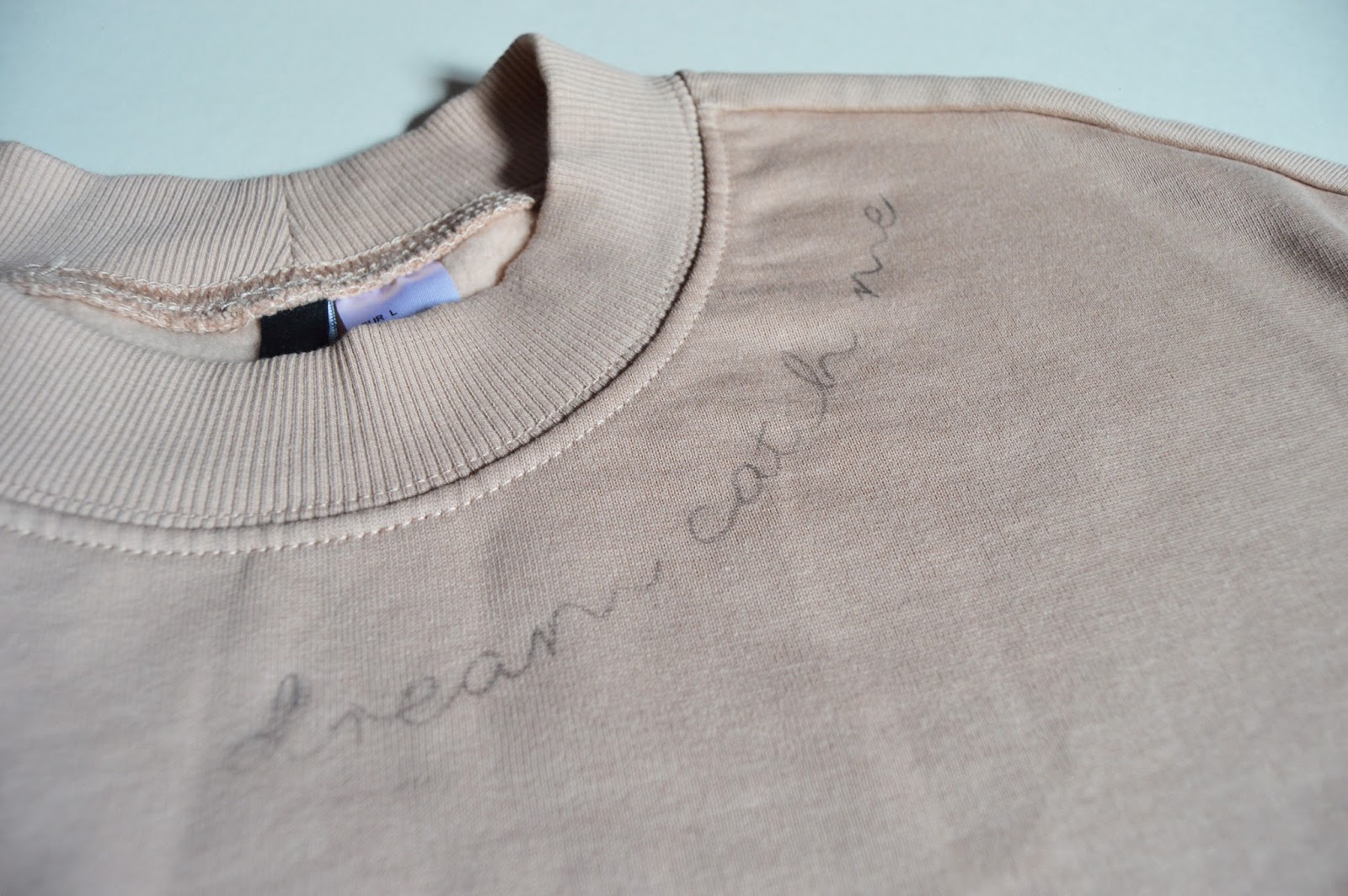
I decided to embroider a sweatshirt rather than a t-shirt and I found this oversized somewhere-between-nude-and-blush-pink one in H&M. It's not somewhere I usually shop, but I'd gone in as part of a massive hunt for the perfect yoga leggings and I found it reduced to £6! I've got a bit of a thing about collarbones so I've curved the text so it sits just under the neckband rather than having it straight on the chest.

I'm so happy with it! It's not strictly supposed to be oversized, but I bought a large so I could roll the sleeves up and wear it baggy. I chose to embroider the words 'dream catch me' which is part of a line from the Newton Faulkner song of the same name.  We walked back down the aisle to it after we got married - ever the sentimental soul me!

Anyway - on to the tutorial:

You will need:

Sweatshirt (or whichever item of clothing you want to embroider)
Embroidery Thread
Needle
Embroidery Hoop
Tissue Paper (or tracing paper which would probably have been easier if I'm honest)
A Soft Pencil
Air Erasable Pen

Optional:

Iron on embroidery backing


How too:

Unless you can do beautiful cursive lettering, you'll need to type your chosen phrase in a font that you like. I used a free font called 'fox in the snow', but a quick search for cursive fonts will bring up millions so choose one you like that isn't too complicated or tightly looped as you'll need to be able to embroider it.

Using an image editor, type your chosen phrase and resize it to fit nicely on your piece of clothing. If you want it to curve as mine does, any programme with a 'text warp' or 'word art' type of function that will curve your text is perfect.

Next, you'll need to flip your text so it's backwards. If you're happy to trace the text straight from the screen, hold your tracing paper over the lettering and trace with a soft pencil. If you can't, or don't want to do to this on the screen, you can print it out, but make sure when you're sizing your text to fit your item of clothing you're viewing it at 100%. If you've printed your text hold the paper up to a window (technical!) place a piece of tracing paper over this and draw over the text.

If you've not been able to flip your text, you can print it out the right way round, then hold it up to the window backwards. You should still be able to see it well enough to trace it.

Whichever way you choose to do it, you need to end up with a piece of tracing paper with your chosen phrase written on it backward in soft pencil. Are you following so far? This is very simple, honest!


Next, position your text, pencil side down in position on the item you'll be embroidering and using the back of your fingernail, or the wrong end of a pencil gently rub over the whole surface. I used tissue paper which wasn't the best idea as it was very flimsy, so you will be able to be a bit more forceful with your tracing paper.


This should leave a feint pencil line on your item. You can then draw over this with an air erasable pen which will make it much easier to see and also much less likely to rub off. The other bonus is that  the pen will fade in 24 hours so you'll be much less likely to leave your project half finished and think 'Oh I'll finish that later' then come back to it in four years time when it's crumpled up and you can't even remember what it was supposed to be. I can't be the only person guilty of this...    


Once you've got your text successfully transferred onto your jumper, use an embroidery hoop to pull the fabric taught. To say this next part feels like a bit of an insult, but I'd be lying if I said I hadn't made similar daft mistakes...make sure you only put the hoop on the layer of fabric you'll be stitching on to - don't stitch the front and back together!


Cut a length of embroidery thread and split the strands in half so you've got two three-strand lengths. Tie a knot in one end and thread the other onto a sharp, fine needle. Using back stitch, work along the length of your text with small even stitches. (If you're unsure about how to do backstitch, Mollie Makes Library of Embroidery Stitches will be helpful here)


Tie off your thread at the end, and you're done! If you want to make your stitching more secure, and stop the stitching rubbing if you've embroidered a t-shirt or something else worn next to the skin, you can iron a piece of embroidery backing onto the reverse.


Raku Firing Experience: The Good Life Experience


Last September I was invited to spend the weekend in Wales at the Good Life Experience, and it truly changed my life! I wrote a post about it here, but one of the most magical experiences I had over the whole weekend was raku firing, something that had been on my bucket list for years since learning about it at university. In light of The Great Pottery Throwdown being back on TV, I wanted to share my raku experience (prepare yourself for some over the top grinning!) 


The workshop was run by a group of local potters, and there were several hand thrown pots to choose from. I chose to work on a little pot with a foot and some gouged markings. Raku is a somewhat unpredictable method of glazing and firing, so the emphasis was on working instinctively, not overthinking the process and letting the glazes act naturally - just the way I love to work with materials, letting their qualities and characteristics determine the outcome of the end product. 

I began by dipping the pot diagonally into the white glaze, then filled it and poured it back out to coat the inside with glaze. 


Then it was onto dripping the glaze and copper oxides. The pale blue becomes a rich turquoise with hints of copper depending on the firing, and the brown becomes a bright green. I wanted a vaguely painterly finish that followed the gouged marks in the pot, but I struggled with the definitely right-handed ladle and ended up embracing a much more haphazard finish.


Once we were happy with the glazing, the bottoms of the pots were cleaned so any glaze that may have got onto them didn't stick to the kiln and cause the pots to crack. They were them placed into the raku kiln and heated to a completely terrifying 1000 degrees centigrade which took about 20 minutes.  The workshop I took part in happened in the early evening, but they continued well into the night and we went back to watch the firing process happening in the dark which was quite incredible!   


Once heated to the magic 1000 degrees, the pots were very carefully removed and immediately placed into troughs of sawdust which ignite as soon as they come into contact with the scorching pot. More sawdust was thrown on top, and the troughs quickly sealed. It's this process which causes the glazes to crackle and the unglazed parts of the pot to become black thanks to the carbon residue from the burning sawdust. 


When the pots come out, they were quickly plunged into cold water to cool them before we set about cleaning off the carbon left behind on the glazed parts, revealing the finished pot and seeing how coppery the oxides had become! 

I was pleased to see some of the turquoise areas of mine had become a pleasingly bright copper around the edges. I decided to leave a little of the black residue on mine as I quite liked the contrast it gave.  


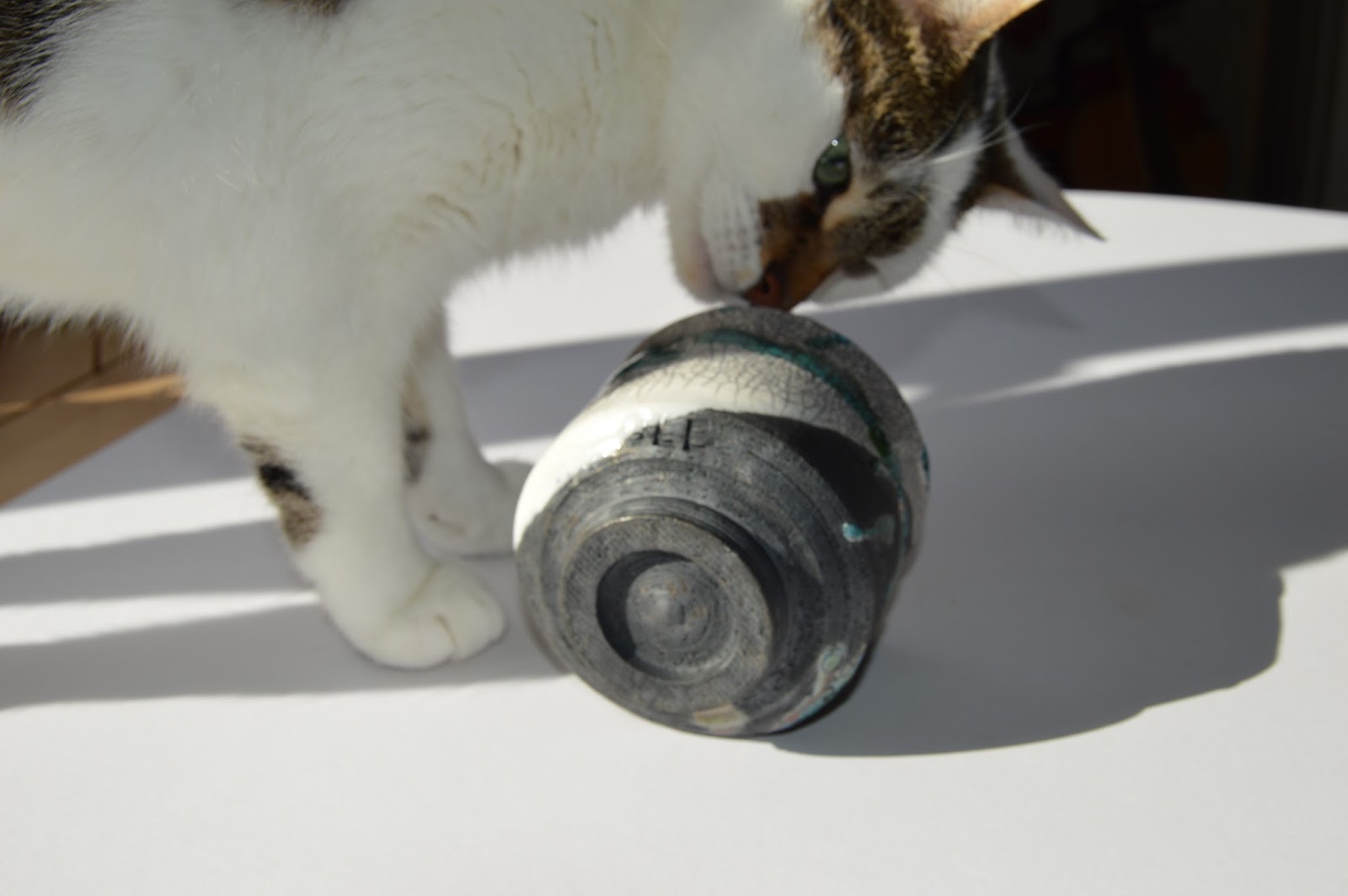
It was the best fun, and I'll treasure this little pot forever! At the moment it's hidden away (out of reach of the cat) which is a bit of a shame, but I'm not really sure what I should use it for. I don't really want to plant something in it as the inside is so pretty, and it's not food safe. Maybe I'll have it out on display somewhere to remind me of that magical day in September! If you'd like to read more about our weekend at the festival you can find it here.


Tutorial: Easy Leather and Copper Hanging Planter Update


Like most of us plant lovers, I've got quite the collection! Mostly they adorn windowsills and side tables, but as we're decorating at the moment I've been planning to spread them around the house a little more and give them proper homes! 

I like the idea of hanging planters, and there are some really affordable ones around - but, they're often let down by cheap looking hangers. I bought this small one in Tiger, and the shape is fun but I wasn't really a fan of the cord hanger. My sister bought me the larger one for Christmas, and while I love the dipped copper effect, the rope hanger was far too bulky and didn't feel like it would support much weight.


So, I untied the old hangers and using some leather cord and copper wire, made some hangers that are a lot simpler and much more in-keeping with the general feel our finished rooms will have. 


For the larger one which has three hanging points, I cut three lengths of leather, and threaded one (from the inside) through each hole, then secured it in place by wrapping it tightly with a length of copper wire.


If you have a go at this yourself, make sure to wrap the wire really tightly, and pull each piece of leather firmly to make sure it will be able to take the weight of a plant. If you were doing this with a much larger and heavier pot you could glue the leather in place first then cover the glue with the wrapped copper. 


Once you've done all three, gather up the ends and make sure they're still roughly equal. 

Next, I decided to add a wooden ring (an old curtain ring) to add a little interest and also so the hanger can be suspended from one piece of leather rather than trying to attach all three together, thus creating the same bulk I was trying to avoid! 


Next, I removed the hook from the ring and replaced it with another length of leather. I made a second loop at the top for hanging, and wrapped a small section of the ring with some more wire. 


For the small planter, I simply replaced the single length of black cord that was knotted at each end with a length of leather secured with wrapped wire! 


They're still awaiting their plants, I haven't quite decided yet which ones are going where, but I much prefer their new look! 


SaveSave