Showing posts with label Fabric and Sewing. Show all posts

DIY Tutorial: Embroidered Slogan Sweatshirt


I've been seeing an awful lot of embroidered slogan t-shirts recently, plain t-shirts with cute (sometimes cute, sometimes they're crap) sayings embroidered on the chest, sort of where the breast pocket would be.

I've been wanting to make something similar as I love a good quote or slogan (three out of the six tattoos I have are text based) plus embroidering lettering is one of my favourite things to do to switch off because it's sort if mindless but really satisfying at the same time. The lighting in these photos is a bit weird, so just ignore that bit...


I decided to embroider a sweatshirt rather than a t-shirt and I found this oversized somewhere-between-nude-and-blush-pink one in H&M. It's not somewhere I usually shop, but I'd gone in as part of a massive hunt for the perfect yoga leggings and I found it reduced to £6! I've got a bit of a thing about collarbones so I've curved the text so it sits just under the neckband rather than having it straight on the chest.

I'm so happy with it! It's not strictly supposed to be oversized, but I bought a large so I could roll the sleeves up and wear it baggy. I chose to embroider the words 'dream catch me' which is part of a line from the Newton Faulkner song of the same name.  We walked back down the aisle to it after we got married - ever the sentimental soul me!

Anyway - on to the tutorial:

You will need:

Sweatshirt (or whichever item of clothing you want to embroider)
Embroidery Thread
Needle
Embroidery Hoop
Tissue Paper (or tracing paper which would probably have been easier if I'm honest)
A Soft Pencil
Air Erasable Pen

Optional:

Iron on embroidery backing


How too:

Unless you can do beautiful cursive lettering, you'll need to type your chosen phrase in a font that you like. I used a free font called 'fox in the snow', but a quick search for cursive fonts will bring up millions so choose one you like that isn't too complicated or tightly looped as you'll need to be able to embroider it.

Using an image editor, type your chosen phrase and resize it to fit nicely on your piece of clothing. If you want it to curve as mine does, any programme with a 'text warp' or 'word art' type of function that will curve your text is perfect.

Next, you'll need to flip your text so it's backwards. If you're happy to trace the text straight from the screen, hold your tracing paper over the lettering and trace with a soft pencil. If you can't, or don't want to do to this on the screen, you can print it out, but make sure when you're sizing your text to fit your item of clothing you're viewing it at 100%. If you've printed your text hold the paper up to a window (technical!) place a piece of tracing paper over this and draw over the text.

If you've not been able to flip your text, you can print it out the right way round, then hold it up to the window backwards. You should still be able to see it well enough to trace it.

Whichever way you choose to do it, you need to end up with a piece of tracing paper with your chosen phrase written on it backward in soft pencil. Are you following so far? This is very simple, honest!


Next, position your text, pencil side down in position on the item you'll be embroidering and using the back of your fingernail, or the wrong end of a pencil gently rub over the whole surface. I used tissue paper which wasn't the best idea as it was very flimsy, so you will be able to be a bit more forceful with your tracing paper.


This should leave a feint pencil line on your item. You can then draw over this with an air erasable pen which will make it much easier to see and also much less likely to rub off. The other bonus is that  the pen will fade in 24 hours so you'll be much less likely to leave your project half finished and think 'Oh I'll finish that later' then come back to it in four years time when it's crumpled up and you can't even remember what it was supposed to be. I can't be the only person guilty of this...    
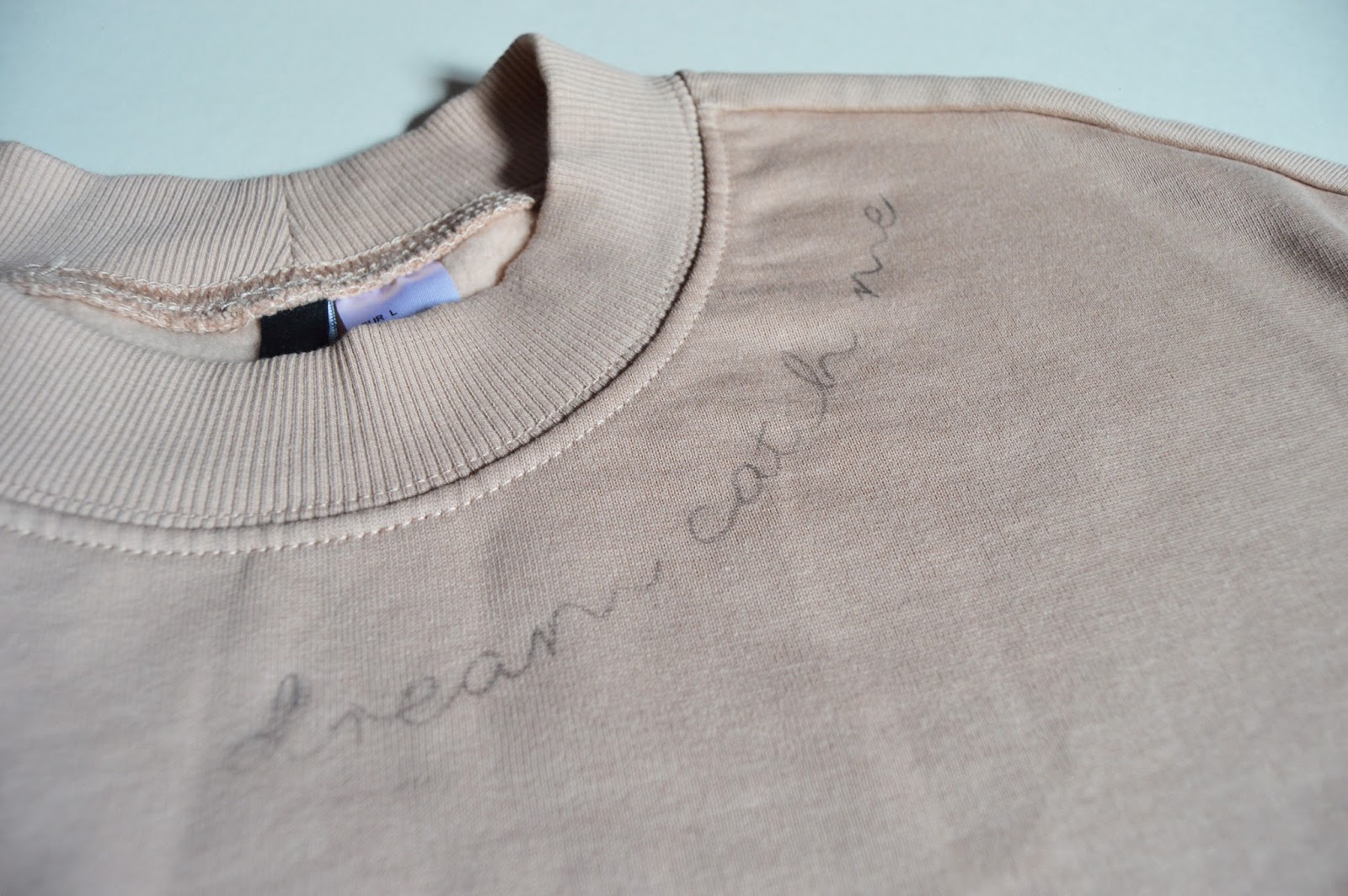


Once you've got your text successfully transferred onto your jumper, use an embroidery hoop to pull the fabric taught. To say this next part feels like a bit of an insult, but I'd be lying if I said I hadn't made similar daft mistakes...make sure you only put the hoop on the layer of fabric you'll be stitching on to - don't stitch the front and back together!


Cut a length of embroidery thread and split the strands in half so you've got two three-strand lengths. Tie a knot in one end and thread the other onto a sharp, fine needle. Using back stitch, work along the length of your text with small even stitches. (If you're unsure about how to do backstitch, Mollie Makes Library of Embroidery Stitches will be helpful here)


Tie off your thread at the end, and you're done! If you want to make your stitching more secure, and stop the stitching rubbing if you've embroidered a t-shirt or something else worn next to the skin, you can iron a piece of embroidery backing onto the reverse.


Tutorial: Ice Dying


I first saw ice dyed fabric in the window display of the Regent Street Anthropologie and fell in love with the abstract, painterly, watery feel it gives.

As our bedroom (at some point in the future when we get around to finishing it!) will be vaguely nautical and beachy, I jotted the idea down as I thought it would make the most amazing sort if focal point bedding! I  finally got around to giving it a try a few weeks ago.  There are a few tutorials around, but the method and the type of dye varies a lot so I just grabbed some a couple of different colours of Dylon hand dye, a super cheap white cotton bedding set and decided to make it up as I went along!


I'm so pleased with how it came out! I was going for a sort-of-ombre look, with the deeper blue at the foot of the bed, then fading to the paler blue and leaving the top edge of the duvet cover white. The dye spread a lot more than I had imagined so although I got the dark to light fade, the white edge didn't really happen.  

I'm definitely going to get some better quality bedding and make another set and tweak my method slightly, but if you'd like to have a go yourself here's what you'll need:

- Powdered hand dye (I used Dylon in Jeans Blue and Ocean Blue)
- The items you want to dye - check the dye packet to make sure your dye is suitable for that type of fabric, cotton/natural fabrics will always take colour better than synthetics (I did the duvet cover and pillow cases at the same time and it was fine, although the dye suggests this would be too much fabric. I think because the powdered dye comes into direct contact with the fabric the colour will be brighter than if you were to dilute it)
- Table salt (or whichever fixing agent your dye packet suggests!)
- A big bag of ice
- A large tray to catch the melting ice (I used the seed tray I was supposed to take back to my Grandad which is still in the garage - whoops)
- A rack of some sort so you can suspend your fabric over the tray and let the ice drip through. Something like a cooling rack, or one of those wire steps you put in the cupboard to give yourself more space. I used two upside down cutlery trays which worked well except for the fact the they're metal. I would DEFINITELY recommend using something plastic coated because although the wet fabric was only sitting on it over night, mine started to go rusty so I have a couple of little rust marks near the buttons of my duvet set.
- Washing up bowl
- Plastic sheets to cover your bare wood dining table so you don't get a big blue stain right in the middle that means you need to sand and refinish it (can you tell I did not do this and am talking from experience?)


First of all, you need to soak your fabric in whichever fixing solution your dye suggests. I made up a washing up bowl with the water and salt quantities for both sachets of dye (which I think was 2l of water and 500g salt) and soaked the duvet cover and pillow cases for a good 20 minutes. There was a lot of fabric to try and fit in there so I kept coming back to it and turning it over or prodding it down to make sure it all got soaked.


Next wring the fabric out, and tip the salty water away. Position the racks above the tray you'll be using to catch the melting ice, then place your wet fabric on top. I had planned for the top edge of the duvet cover to stay white so I didn't pile this on the rack but let it hang over the edge into the washing up bowl.


The way the fabric is positioned will affect how pattern ends up so you can have a bit of a play with twisting or folding it to create different effects. I didn't realise at the time but I actually managed to leave the duvet cover folded in half down the middle which has meant it's ended up symmetrical which isn't ideal! I tried to make a sort of wavy pattern and put in a couple of big twists.

I then laid the pillow cases on top of the duvet cover, and again let one short edge of each hang over into the washing up bowl hoping this would give a sort of left-to-right fade.


So, onto the dying! First off, pile as much ice as you can manage on top of the fabric, I managed to fit about a bag and a half on top before it started falling off! I got really carried away with taking photos because it just looked so pretty and crystaly! 


Then, open up your packets of dye, and start sprinkling! I used the darker colour at the bottom (or foot end) of the quilt cover and then the lighter colour at the top, blending them a little in the middle. 


It is so much fun!! It was so fascinating watching the powder start to dissolve on the ice and I didn't really know when to stop so I just kept going until it looked like the powder wasn't dissolving anymore. Then I realised there was such a small amount left I just chucked the rest of the dye on and hoped for the best. 

I was really worried at this point because although the Denim Blue looked great (you can see it down towards the bottom left) the ocean blue looked decidedly purple and purple is my least favourite colour so I really didn't want purple bedding! 


Then just leave it until all the ice has melted! I was totally obsessed with it and kept sneaking into the dining room to have a look at how things were progressing! It's so pretty, and it's so much fun watching the colours slowly soak through the white fabric.  


When I went to bed, this is how it was looking. I was rather concerned about the purple at this point but pleased with how it was fading towards the top edge. I'm not really sure why the different pigments in the dye seem to separate, but for some reason it all looked a bit orange!  


So, when the ice has all melted, it's time to rinse! I was too excited and forgot to take any pictures, but by the time I woke up the purple had turned a much more pleasing blue! 

I rinsed all my fabric in the bath which was definitely easier than trying to fit it all in the sink but I did stain the bottom of my bath blue which isn't ideal.

When you've rinsed the fabric as much as you can and the water is running clear (or nearly clear - it will take a quite long while!) pop it all on a quick wash with a normal dose of laundry detergent then hang it out to dry! 


I love it, and I think I might be in love with this method of dying too! It totally reminds me of swirling waves and inky ocean depths and the flashes of white that did get left un-dyed are like the crests of a breaking wave. The faded effect came out much better on the pillow cases than the duvet cover too. I'm definitely going to get a much better quality bedding set and make another set, and I think I might just go with the Jeans Blue colour as I'm not a massive fan of the still somewhat lilac-y Ocean Blue. I really want to try it with linen, but I'm not sure I'm feeling brave enough to dye expensive linen in such an unpredictable way...we shall see! 

So yes - I hope if you try it out you love it too, I'd love to hear how you get on if you do!
SaveSave

Sew Along Toddler Backpack {Part Three - Finishing}

Just in time for some Sunday making, we've reached the last stage of our backpack sew-along! I'm really hoping some of you have nearly finished backpacks just waiting for the finishing touches. If you've missed the first two parts, you can find them here:


For the final stage of this tutorial you will need:

  • 4 'D' Rings for the strap adjusters
  • One Toggle
  • Cord for the drawstring opening
  • Beads for the cord-ends
  • Velcro/popper for fastening the flap - I used permanent, self adhesive velcro
  • A safety pin
  • Sewing machine and thread
  • Scissors 
  • Iron and ironing board

So, if you've completed parts one and two, your backpack should be very nearly finished and be looking something like this...


First, were going to secure the lining to the inside of the bag so it stay s in place and looks nice and neat around the top.

Making sure the lining is evenly tucked inside the bag, give it a good press with the iron. We will be sewing close to the top edge of the bag, just below where the lining is attached.  Place under the machine foot making sure that the flap and straps are kept well out of the way, you don't want to catch anything under the needle at this stage! 


Using the edge of the presser foot as a guide, top stitch all the way around the top of the bag, beginning and ending at a seam.


Next, we need to close up the hole in the bottom of the lining. Pull it out of the bag and use pins to neatly close the opening, tucking the raw edges inside. You could hand stitch this for extra neatness, but given that it will be on the inside of the bag, I went for the more secure option of simply topstitching the opening closed.  


Push the lining back inside the bag, making sure it is evenly in place. We're now going to sew the channel which will later contain the drawstring cord. Measure the distance between the top of your button hole and the previous line of stitching you made around the top of the bag, then measure the same distance away from the bottom of the button hole and make a mark. Replicate this mark every so often around the whole opening of the bag, then join the marks up with a row of stitching.  


Thread the end of your drawstring cord onto a safety pin, I chose a red and white striped bakers twine style cord. Feed the safety pin into the button hole and use it to draw the cord along the channel between the two rows of stitching.


Once you've worked the safest pin all the way around, pull it back out the the button hole - cute or what!! 


Thread the toggle onto both ends of the cord, then trim the cords so they're just long enough to allow the toggle to be let out all the way, then thread a bead onto each end. I used some yellow wooden beads I found in Tiger. 


Now to finish the straps! Take two 'D' rings and thread them onto one of the sections of strap attached to the top of the bag. Fold the webbing under and secure with some bulldog clips while you machine sew in place. I sewed backwards and forwards 3-4 times as close to the 'D' rings as the foot of the machine would allow. Trim off any excess, then repeat on the other side making sure they are the same length.


Undo your drawstring toggle, and flatten out the sop of your bag. To secure flap I used a permanent stick on velcro dot, but you could use a popper, magnet, or other fastening (though bare in mind you may need to add it earlier on in the process if you don't want it to be seen from the other side)

To make sure the dots are perfectly lined up, peel the backing off one side of the velcro, and stick it to the corresponding piece, then stick both sides to the inside of the flap. Peel off the other piece of baking paper, and carefully close the flap, pressing down the velcro so the adhesive sticks the second dot to the front of the bag. Leave it in place for a few minutes then you should be able to carefully re-open the flap, leaving the velcro dots stuck in place. 


The very last job is to join up the strap pieces! Take the bottom piece of webbing and thread it up through both 'D' rings, then back down over the top ring, and under the bottom one. This will allow you to adjust the length of the straps as the wearer grows (or the bag gets borrowed!) 


And there you have it! One finished toddler sized back pack ready to be filled with books and snacks, pine cones and pebbles or other secret bits and bobs! 


I really hope you've enjoyed this series! If anyone has followed along and actually made a backpack I would absolutely love to see them, and would also really appreciate any feedback on this style of tutorial! 

Happy October everyone!